 Strata Design Journal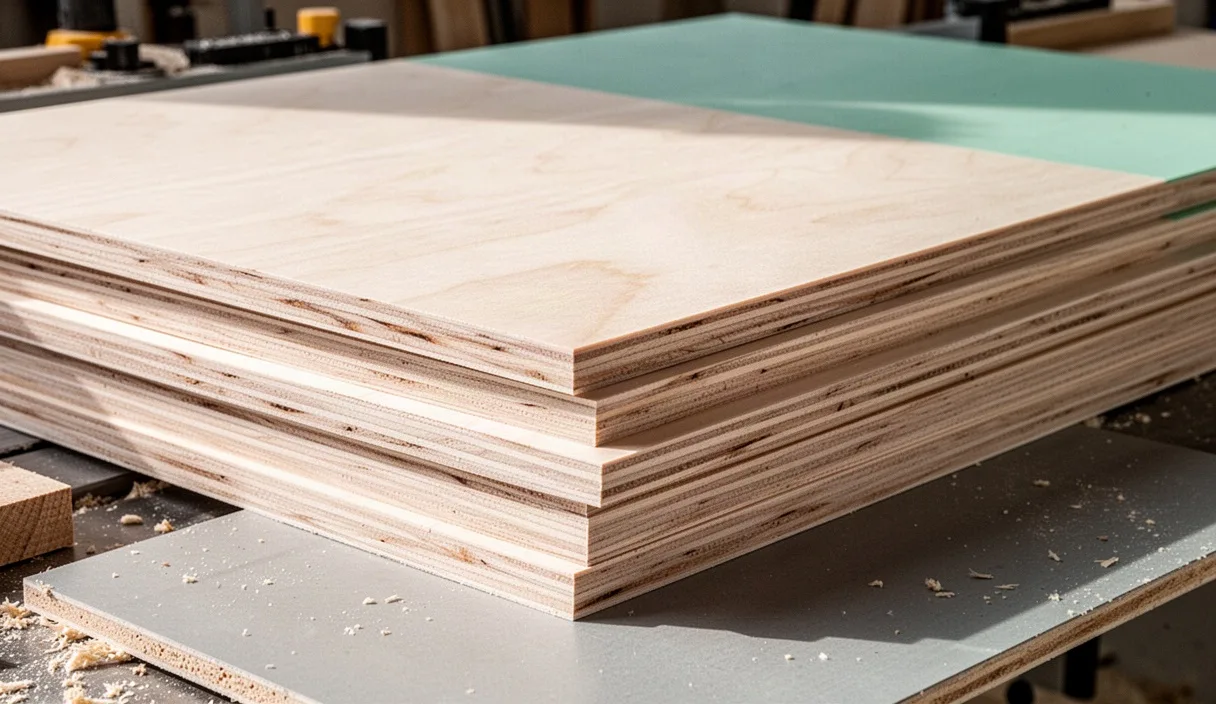

Commercial interior joinery, architectural paneling, and heavy retail fixtures operate under mechanical demands that standard residential casework never encounters. High-traffic environments subject panel goods to constant cyclic loading, unpredictable humidity swings, and severe point impacts. Specifying plywood on commercial contracts requires treating the panel as an engineered structural composite rather than a simple aesthetic substrate. When procurement teams treat plywood as a commodity product and order based purely on nominal thickness and price per sheet, millwork shops face blown veneer faces, delamination under solvent-borne finishes, and mechanical joint failure in the field.
Every commercial specification sheet must define three physical attributes: the veneer face grade, the adhesive resin system, and the internal core construction. Skipping any single parameter leaves the purchasing department free to substitute inferior variants that comply with the nominal callout while failing basic fabrication requirements. Establishing clear panel performance criteria protects the fabricator from costly rework and ensures that architectural fixtures endure decades of commercial turnover.
Veneer Surface Grades: Understanding B, BB, CP, and C Designations
Surface veneer grades control both the cosmetic appearance and the structural uniformity of the outer plies. The Russian and European grading scale (B, BB, CP, C) governs birch plywood and dictates how many defects, synthetic fills, and wooden patches a manufacturer can introduce across a square meter of panel face. Specifiers must choose a face grade tailored to the exact finishing method, balancing unit cost against the labor required to prep panels for clear coat, paint, or high-pressure laminate overlays.
Grade B represents the highest standard commonly available for commercial millwork. It permits small sound pin knots up to 6 mm in diameter and minor natural color variations, but it strictly forbids synthetic putty patches or boat-shaped wood patches. B-grade faces serve projects requiring clear, transparent conversion varnishes or light stains where natural grain continuity remains paramount. Grade BB introduces oval wood patches, often referred to as butteries or boat patches, applied to replace larger knots before final sanding. BB permits up to 3 or 4 color-matched patches per square meter and accepts sound tight knots up to 15 mm. This grade functions as an industrial substrate for direct painting or heavy-pigment stains where the surface contour remains flat despite visual color changes across the patches.
Grade CP (cut-patch) and Grade C denote utility panels intended for non-appearance applications or heavy structural packaging. CP allows an unlimited number of wood patches and open surface splits up to 0.5 mm wide, filled with resin putty but rarely color matched. Grade C permits open knotholes up to 25 mm, wormholes, splits, and bark pockets without repair. Using Grade C or CP as a substrate for thin decorative veneers or high-gloss laminates causes telegraphing: voids, fills, and grain dips mirror through the face material under raking retail light.
| Grade | Allowed Knot Size | Wood Patches Permitted | Primary Commercial Application |
|---|---|---|---|
| B | Sound pin knots under 6 mm | None permitted | Architectural panels, clear lacquers, stain grade |
| BB | Sound knots up to 15 mm | Selected, color-matched wood inserts | Painted millwork, general casework boxes |
| CP | Knots up to 30 mm | Unlimited synthetic putty and wood patches | Concealed framing, heavy-pressure thick laminate bases |
| C | Open knotholes up to 25 mm | Unpatched open defects allowed | Crating, structural substructures, temporary bracing |
When writing specifications, identify both sides of the panel independently. A callout for B/BB ensures one clear face for architectural display and one utility face suitable for interior cabinet bodies or concealed wall-cleat anchoring. A specification for BB/BB suffices when applying thick vinyl or high-pressure laminate (HPL) to both panel faces.
Glue Line Classifications Under European Standard EN 314-2
The adhesive system binding the individual wood plies dictates how a panel responds to moisture exposure, chemical cleaners, and ambient humidity cycling. European Standard EN 314-2 classifies adhesive bond quality into three distinct categories based on shear-strength testing after controlled pre-treatments, such as water immersion and boiling. Specifying the wrong glue line in a commercial wet area, such as a restaurant washroom or exterior-facing storefront, causes catastrophic edge delamination within months of installation.
Class 1 bonds rely primarily on urea-formaldehyde (UF) resins and suit dry interior applications exclusively. These panels require a service environment where the equilibrium moisture content of the wood remains below 10 percent and temperatures stay within typical conditioned indoor ranges. Class 1 panels must not encounter standing water, high atmospheric vapor, or chronic moisture exposure. They function adequately for interior office partitions, library shelving, and dry retail display units.
Class 2 bonds, commonly referred to as humid interior adhesives, utilize melamine-urea-formaldehyde (MUF) formulations. Under EN 314-2 testing, sample coupons must retain specific shear failure limits after soaking in water at 20 degrees Celsius for 24 hours. Class 2 panels tolerate occasional brief exposure to water and sustained relative humidity levels reaching up to 85 percent for limited cycles each year. Specify Class 2 adhesive systems for multi-unit residential kitchens, hotel vanities, gym locker bases, and commercial restrooms.
Class 3 bonds represent exterior-grade structural resins, predominantly phenol-formaldehyde (PF) or water-boiled-proof (WBP) formulations. To satisfy Class 3, test specimens undergo a 4-hour boil in water, followed by 16 hours of oven drying at 60 degrees Celsius, a second 4-hour boil, and immediate cooling before physical shear testing. Class 3 adhesives show complete resistance to weather, fungal attack, and structural boiling water. Specify Class 3 for exterior retail canopies, public transportation bench substrates, and marine-adjacent hospitality fixtures.
Core Composition: Solid Core Birch Versus Voided Softwood
The interior architecture of a plywood sheet determines its bending stiffness, dimensional stability, and edge-machining characteristics. Specifiers evaluating sheet goods for CNC machining, pocket-hole joinery, or exposed-edge detailing must contrast multi-ply Baltic or European birch against traditional construction-grade softwood plywoods made from radiata pine, Douglas fir, or southern yellow pine.
Solid core birch panels use rotary-cut plies that average 1.4 mm in thickness. An 18 mm solid core panel contains 13 balanced plies cross-laminated perpendicularly. Because Baltic and European mills inspect and grade inner plies before layup, solid core birch sheets feature minimal core voids. The cross-laminated construction yields uniform physical and mechanical properties along both major axes. This structural density (averaging 680 to 710 kg per cubic meter) allows fabricators to cut intricate joints, mill exposed bullnose edges, and rout precise shelf dados without encountering interior gaps that ruin edge profiles or reduce glue surface area.
In contrast, standard softwood plywood typically uses thicker core veneers ranging from 2.5 mm to 3.2 mm. An 18 mm softwood panel contains between 5 and 7 plies. Softwood logs produce larger natural knots, which fall out during rotary peeling and leave open voids inside the panel core. While manufacturing standards permit interior core gaps up to 25 mm wide in utility sheathing, these cavities create severe mechanical vulnerabilities in heavy commercial millwork. Cutting through an internal void leaves edge-banding tape unsupported, compromises screw-thread engagement, and creates weak pockets that crush under heavy localized clamping loads.
- Ply Count Density: 18 mm birch provides 13 plies, creating 12 distinct glue lines that resist shear failure, whereas 18 mm softwood provides 5 to 7 plies with only 4 to 6 glue lines.
- Edge Integrity: Solid core birch panels allow direct finishing of the raw edge with sanding and clear sealer, creating a distinct linear aesthetic. Voided softwood cores always require solid wood lipping or PVC edge-banding to conceal interior blowouts.
- Bending Modulus: Birch panels demonstrate a modulus of elasticity exceeding 9,000 N per square millimeter along the grain, while softwood options average between 5,500 and 7,200 N per square millimeter, demanding shorter spans between support ribs to prevent shelf sag.
Screw Retention Values and Edge-Banding Considerations
Mechanical fastening in commercial assemblies relies heavily on the panel's ability to resist screw pull-out and splitting under load. Screw holding capacity correlates directly with wood density and the frequency of glue lines per millimeter of thickness. In high-abuse settings, such as commercial classroom desks or hospital storage walls, joinery must hold fasteners against dynamic vibration and shear stress.
Standard withdrawal tests demonstrate significant performance gaps between panel core types. A number 8 gauge commercial wood screw driven 25 mm into the face of a solid birch panel achieves a pull-out resistance value exceeding 1,550 Newtons. The same screw inserted into the face of an economy softwood panel yields between 900 and 1,150 Newtons, depending on whether the threads bite into dense latewood or soft earlywood. For edge fastening, the difference is more pronounced: birch edge screw holding averages 1,200 Newtons, whereas voided softwood edges frequently split or hit an internal air gap, dropping withdrawal resistance below 450 Newtons.
To maximize mechanical performance in edge-fastened commercial millwork, enforce the following fastening protocols:
- Drill pilot holes sized precisely to the root diameter of the screw. For a 4.0 mm wood screw, use a 2.8 mm pilot drill in birch and a 2.5 mm pilot drill in softwood cores.
- Maintain a minimum edge margin: never drive a fastener closer than 35 mm to a panel corner, and space edge fasteners at least 75 mm apart to distribute lateral splitting forces.
- Avoid wedge-head drywall screws; use flat-bottom twin-fast or parallel-shank cabinet screws featuring deep, sharp threads that compress the wood fibers instead of shearing through the veneer layers.
When applying edge-banding to composite panel edges, adhesive selection controls durability. Hot-melt ethylene vinyl acetate (EVA) glues provide sufficient adhesion for standard office environments with stable climates. However, heavy commercial work subject to aggressive cleaning solutions, high humidity, or direct heat requires polyurethane reactive (PUR) hot-melt adhesives. PUR forms a chemical cross-link as it support with atmospheric moisture, creating an insoluble, waterproof barrier that prevents chemical strippers and moisture from swelling the core edge. Specify a minimum 1.5 mm thick impact-resistant ABS or PVC banding applied via PUR adhesive for high-traffic casework edges, particularly where panels interact with cleaning machinery or food service carts.
Formaldehyde Emission Classes: E1 Standards Versus NAF Products
Indoor air quality mandates in commercial buildings frequently control panel specification through certifications such as LEED v4.1 or the WELL Building Standard. Plywood resins emit volatile organic compounds (VOCs), primarily formaldehyde gas, as unreacted chemical components cure and degrade over time. Specifying panel goods requires navigating European emission classes and North American low-emitting composite wood regulations.
The baseline standard across European panel production is Class E1, governed by standard EN 717-1. To achieve E1 certification, a panel's formaldehyde chamber test release must not exceed 0.124 milligrams per cubic meter of air (0.1 parts per million). While E1 complies with most European municipal building codes, advanced sustainability projects often require E0.5 levels, which cut the maximum permitted emission rate to 0.065 milligrams per cubic meter, matching Germany's tightened chemical prohibition ordinances.
In North America, the regulatory baseline is set by the California Air Resources Board (CARB Phase 2) and Title VI of the Toxic Substances Control Act (TSCA). Projects pursuing superior indoor environmental ratings avoid standard synthetic urea formulations entirely by mandating NAF (No Added Formaldehyde) or ULEF (Ultra-Low Emitting Formaldehyde) panels. NAF products eliminate synthetic formaldehyde altogether, utilizing soy-based adhesives, polyurethane emulsions, or specialized polyvinyl acetate (PVAc) formulations. Specifying NAF plywood guarantees compliance with the most stringent VOC credit categories without requiring complex post-installation air flushes.
| Emission Standard | Regulatory Body / Origin | Maximum Emission Threshold | Adhesive Formulation Type |
|---|---|---|---|
| E1 Standard | European Union (EN 717-1) | 0.124 mg/m³ (0.10 ppm) | Modified Urea-Formaldehyde |
| E0.5 Standard | German ChemVerbotsV | 0.065 mg/m³ (0.05 ppm) | Low-emission Melamine / Phenolic |
| CARB 2 / TSCA VI | United States (EPA / CARB) | 0.050 ppm (Hardwood Plywood) | Controlled Melamine-Urea |
| NAF Products | CARB / USGBC LEED Credit | Zero synthetic additions | Soy, Polyurethane (MDI), PVAc |
Common Specification Mistakes
Project delays and cost overruns frequently trace back to standard omissions on architectural schedules. Review your specification documents to eliminate these frequent failure points:
- Specifying "Marine Grade" for Interior Wet Areas: Specifiers often assume British Standard 1088 Marine Plywood guarantees water resistance for bathroom cabinets. Marine grade ensures Class 3 phenolic glue and void-free cores, but the wood species itself (frequently okoume or meranti) possesses poor natural rot resistance and rots quickly if unsealed water penetrates the finish.
- Omitting the Balance Ply Specification: Laminating heavy HPL (0.8 mm) to the face of a 12 mm or 18 mm plywood panel without applying an equivalent backing sheet to the reverse face causes rapid panel cupping. The unbalanced tension pulls the panel into a permanent curve as humidity fluctuates.
- Calling Out "Cabinet Grade" Plywood: The term "cabinet grade" has no recognized legal or trade standard. Suppliers fulfill this vague callout using soft-core import panels that exhibit widespread core voids, thickness inconsistencies up to 1.2 mm across a single sheet, and paper-thin face veneers that sand through during base prep.
Actionable Steps for Writing Project Specifications
To lock down plywood performance across submittals, follow this direct implementation process for your next millwork package:
- Establish the core construction based on static span calculations and fastener loading. For spans exceeding 800 mm under heavy storage loads, mandate 13-ply solid birch over standard 7-ply alternatives.
- Select the EN 314-2 glue line class based on relative humidity expectations. Specify Class 2 adhesive minimum for commercial washrooms, employee break rooms, and perimeter architectural casework. Specify Class 3 for exterior-facing soffits and unconditioned storage areas.
- Define face and back veneer grades explicitly using standard notations. Avoid colloquial terms. Write "Grade B/BB according to EN 635-2" rather than "premium clear veneer."
- Mandate environmental compliance by requiring chain-of-custody documentation: require CARB Phase 2 and TSCA Title VI compliance labels printed directly on panel edges, or specify NAF certified stock where project sustainability credits require third-party verification.
- Demand physical fabrication submittals. Require millwork bidders to submit a 300 mm square edge-banded corner sample exhibiting the exact panel core, glue line, and edge treatment planned for the final assembly. Inspect the sample for core gaps, veneer thickness, and bond strength before approving shop drawings.
Engage structural engineers or certified timber material specialists when specifying load-bearing assemblies, dynamic mezzanine decks, or exterior cladding applications where environmental loads exceed standard interior joinery parameters.